
International Travel Checklist Packing
International trips need more than packing. Enter your departure date and tick what applies — long-haul flight, visa needed, driving abroad, travelling with children or medicines — and the checklist builds a dated countdown of what to do weeks before, days before and on departure day, followed by an international packing list you can print.
- Free to use
- No sign-up
- Runs in your browser
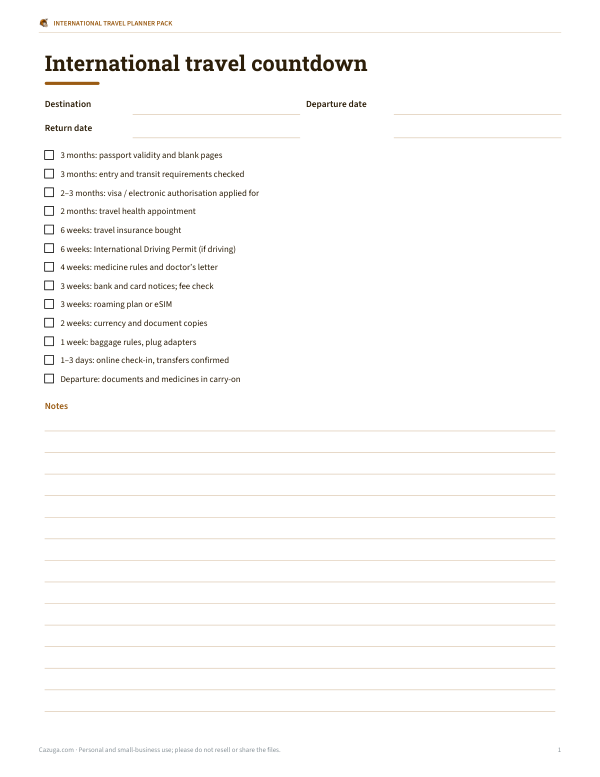
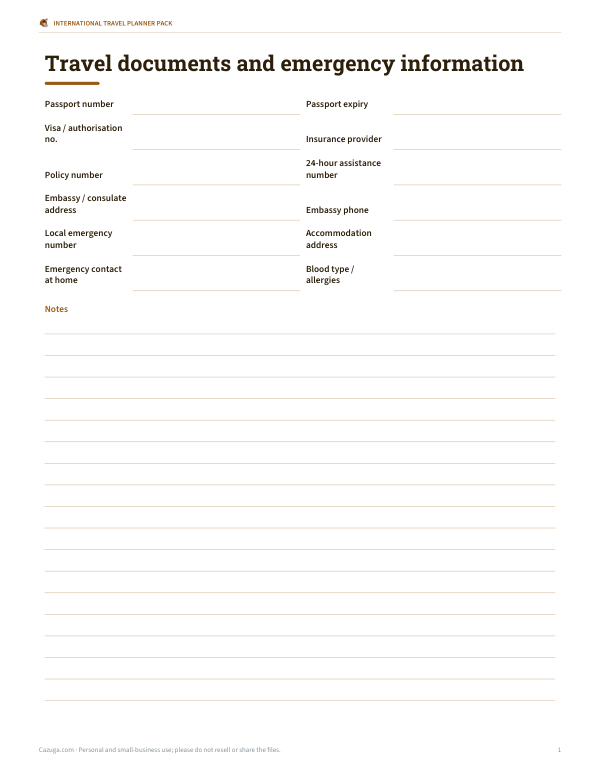
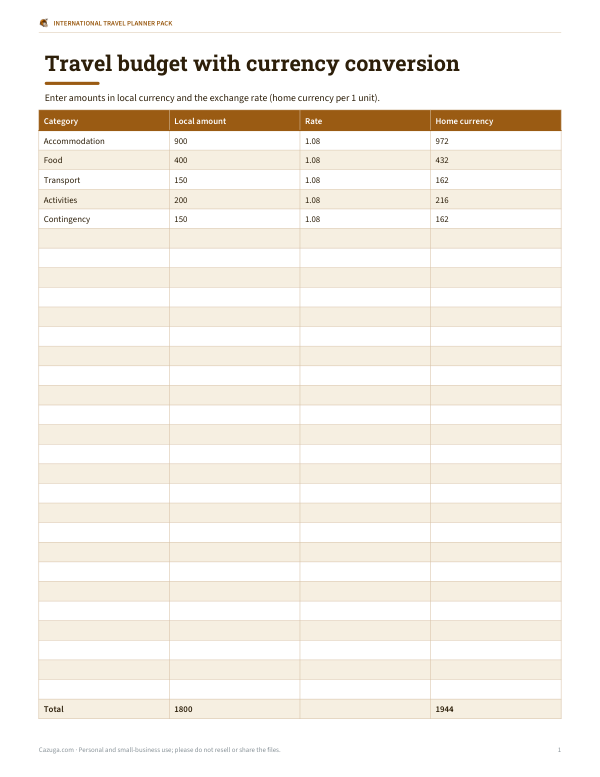
International trip countdown
International Travel Planner Pack
Printable international travel countdown checklist, a document and emergency information sheet, a travel budget workbook with currency conversion and an itinerary planner.
- Countdown checklist (PDF, DOCX)
- Document & emergency sheet (PDF, DOCX)
- Travel budget (XLSX)
- Itinerary planner (PDF, XLSX)
Formats: PDF, DOCX, XLSX. Instant download after payment (link valid 72 hours, up to 5 downloads). AI-assisted: the templates were drafted with AI help and reviewed and laid out before publishing.
$4.00 USD, one-time 4 files · about $1.00 each
- Instant download
- 7-day refund
- Secure checkout by Stripe
7-day money-back guarantee. Full refund within 7 days of purchase, even after you download.
Free sample: International Travel Countdown (PDF, 61 KB)
Full refund within 7 days — see the refund policy and license.
Free printables
Single sheets you can print right now, no sign-up. The full pack adds every sheet in one download plus the editable files.
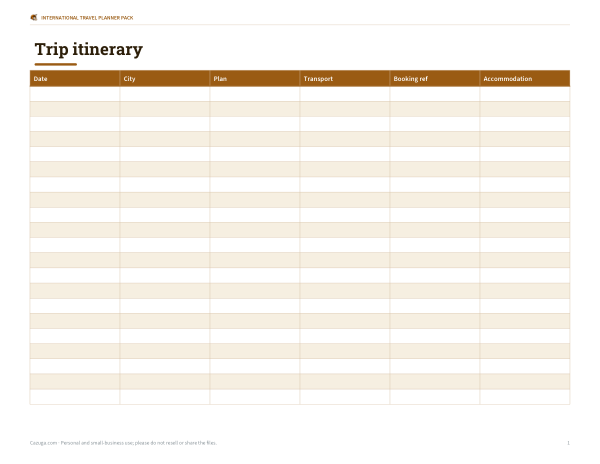 Printable Travel Itinerary Planner
Why international trips need a countdown
Some preparations for travelling abroad take weeks: passport renewals, visas, vaccines that need more than one dose, and international driving permits. Others are easy to forget until the last minute: telling your bank, arranging phone data, buying plug adapters. A dated countdown spreads the work out and makes sure nothing with a long lead time is missed. The checklist above puts each task on a date based on your departure and flags anything that is already overdue.
Passports and entry requirements
- Validity — many countries require your passport to be valid for at least six months beyond your arrival or departure date; the Schengen area requires at least three months beyond departure and issue within the last ten years.
- Blank pages — some countries require one or two blank pages for stamps and visas.
- Visas and electronic authorisations — many trips need a visa or an online authorisation such as the US ESTA, Canada’s eTA or the UK ETA. Rules depend on your nationality.
- Transit — changing planes in a third country can also require authorisation.
- Official sources — check your government’s travel advice and the destination’s official immigration website, not third-party agents.
Health and insurance
Book a travel health appointment six to eight weeks before departure if your destination has vaccine recommendations or malaria risk, since some vaccines need several doses. Make sure routine vaccinations are up to date. Buy travel insurance that covers medical treatment and emergency evacuation — healthcare abroad can be extremely expensive — and check exclusions for pre-existing conditions and activities such as skiing or diving. If you take prescription medicines, check whether they are legal at your destination; some common medicines are controlled in certain countries.
Money and phones
| Task | Why |
|---|---|
| Tell your bank your travel dates | Reduces the chance of cards being blocked for unusual activity |
| Carry two cards from different providers | A backup if one is lost, blocked or not accepted |
| Check foreign transaction and ATM fees | Fees can add 3% or more to every purchase |
| Pay in local currency when asked | Dynamic currency conversion usually costs more |
| Arrange roaming or an eSIM | Avoids expensive data charges |
| Download offline maps and translation | Works without signal |
Documents to copy
- Passport photo page and visa.
- Travel insurance policy and emergency number.
- Flight, hotel and car hire confirmations.
- Driving licence and International Driving Permit.
- Prescriptions and a doctor’s letter for medicines.
- Emergency contacts and your country’s embassy or consulate at the destination.
Keep one set of copies in your luggage separate from the originals, and a digital set in secure cloud storage you can access from any device.
Travelling with children
Children need their own passports in most countries. If a child travels with only one parent or with another adult, carry a signed consent letter from the other parent(s) with contact details, and the child’s birth certificate if surnames differ — some countries and airlines ask for these. Pack snacks, entertainment and a change of clothes in the carry-on, and check car seat rules if you are hiring a car.
Worked example
For a trip leaving on 15 November, the countdown starts in mid-August: check passport validity and entry rules; by early September, apply for the electronic travel authorisation; by 1 October, buy insurance; by mid-October, check medicine rules and get a doctor’s letter; by 25 October, tell the bank and set up an eSIM; in the final week, check baggage rules and buy plug adapters; and the day before, pack documents and medicines in the carry-on.
Customs and what you bring home
Every country limits what travellers can bring in. Food, plants, seeds and animal products are commonly restricted to protect agriculture, and there are duty-free allowances for alcohol, tobacco and goods bought abroad. Cash above a threshold (for example US$10,000 or €10,000 when entering the US or the EU) must be declared. Keep receipts for expensive purchases, and check your home country’s customs guidance before shopping so there are no surprises on the way back.
On arrival
Keep your accommodation address handy for the arrival card and immigration questions. Change a small amount of money or use an ATM inside the terminal. Check that your phone plan is working before leaving the airport, and note the local emergency number. If anything goes wrong — lost passport, serious illness, arrest — contact your country’s embassy or consulate.
Privacy
The checklist is built in your browser; nothing you select is stored or uploaded.
Frequently asked questions
How far in advance should I prepare for international travel?
Start about three months ahead for passports, visas and vaccines; most other tasks can wait until the last few weeks.
How long must my passport be valid?
Often six months beyond your stay; the Schengen area requires three months beyond departure. Check your destination.
Do I need travel insurance?
It is strongly recommended, especially for medical costs abroad; some countries require it for a visa.
What documents should I copy?
Passport, visas, insurance, bookings, licences and prescriptions.
Should I tell my bank I am travelling?
It can help avoid blocked cards; many banks now use app-based travel notices or automatic detection.
Is my information saved?
No, the checklist is generated in your browser.
What is an electronic travel authorisation?
An online pre-approval, such as the US ESTA or Canada eTA, that some nationalities need instead of a visa for short visits.
Do I need an International Driving Permit?
Some countries require one alongside your licence; check the destination’s rules and your rental company’s terms.